


In 2026, both the iPhone 13 Pro and iPhone 15 Pro remain popular choices in the refurbished market. The 13 Pro offers excellent value at a lower price point, while the 15 Pro brings meaningful upgrades: a 48MP main camera, USB-C, a titanium frame, and the A17 Pro chip. This guide breaks down every key difference so you can decide which model makes sense for your needs and budget.
Table of contents
- iPhone 13 Pro vs. iPhone 15 Pro at a glance
- Reasons to choose the iPhone 13 Pro
- Reasons to choose the iPhone 15 Pro
- iPhone 13 Pro vs. iPhone 15 Pro: What are the differences?
- Refurbished value in 2026
- Conclusion
- FAQ
iPhone 13 Pro vs. iPhone 15 Pro at a glance
| Feature | iPhone 13 Pro | iPhone 15 Pro |
|---|---|---|
| Dimensions | 5.78 x 2.82 x 0.30 in 146.7 x 71.5 x 7.65 mm | 5.77 x 2.78 x 0.32 in 146.6 x 70.6 x 8.25 mm |
| Weight | 7.19 oz 204 g | 6.60 oz 187 g |
| Display | 6.1" Super Retina XDR OLED | 6.1" Super Retina XDR OLED |
| Processor | A15 Bionic chip | A17 Pro chip |
| Refresh rate | ProMotion up to 120Hz | ProMotion up to 120Hz |
| Main camera | 12MP, f/1.5 aperture | 48MP, f/1.78 aperture |
| Ultra-wide camera | 12MP, f/1.8 aperture | 12MP, f/2.2 aperture |
| Telephoto camera | 12MP, f/2.8, 3x optical zoom | 12MP, f/2.8, 3x optical zoom |
| Video recording | 4K60 with Dolby Vision | 4K60 with Dolby Vision, ProRes |
| Charging port | Lightning | USB-C |
| Frame material | Stainless steel | Titanium |
| Action button | No | Yes |
| Wi-Fi | Wi-Fi 6 | Wi-Fi 6E |
| Peak brightness | 1,200 nits (outdoor) | 2,000 nits (outdoor) |
| Battery life (video playback) | Up to 22 hours | Up to 23 hours |
| iOS 26 support | Yes | Yes |
| Price (new, at launch) | Starting at $999 | Starting at $999 |
| Price (refurbished) | Starting at | Starting at |
Reasons to choose the iPhone 13 Pro
- Significantly lower refurbished price than the 15 Pro
- Excellent A15 Bionic performance for everyday tasks
- ProMotion 120Hz display with True Tone and P3 wide color
- Capable triple-camera system with 3x optical zoom
- 5G connectivity
- iOS 26 support, keeping it current in 2026
- Wide selection of refurbished units from trusted sellers
Reasons to choose the iPhone 15 Pro
- A17 Pro chip built on 3nm process for significant performance gains
- 48MP main camera sensor with ProRAW and ProRes video
- USB-C port for faster data transfer and universal charging
- Customizable Action button replacing the mute switch
- Lighter titanium frame (187 g vs. 204 g)
- Wi-Fi 6E for faster wireless speeds
- Hardware-accelerated ray tracing for console-quality mobile gaming
iPhone 13 Pro vs. iPhone 15 Pro: What are the differences?
While both the iPhone 13 Pro and iPhone 15 Pro are high-end devices packed with advanced features, there are meaningful differences spanning design, performance, cameras, and connectivity. Here is a detailed look at each.
Design
The iPhone 15 Pro introduces a titanium frame, replacing the stainless steel used in the iPhone 13 Pro. This makes the newer model noticeably lighter at 187 g versus 204 g, a difference you feel during extended use.
The 15 Pro also features slightly curved edges for improved grip and thinner bezels around the display for a more immersive feel.
While the iPhone 13 Pro retains the Lightning port, the 15 Pro adopts USB-C, aligning with the current universal standard for charging and data transfer. This matters in practical terms: you can use the same cable for your iPhone, MacBook, and iPad.
The 15 Pro's camera bump is slightly larger to accommodate its improved hardware, which may affect case compatibility between the two models.
A notable design change is the Action button on the iPhone 15 Pro, replacing the traditional mute switch. This customizable button lets you quickly launch the camera, activate shortcuts, control audio, or trigger accessibility features.
The overall form factor is similar across both models, with flat edges and a premium, squared-off profile. The 15 Pro's titanium finish is slightly more matte compared to the polished stainless steel of the 13 Pro.
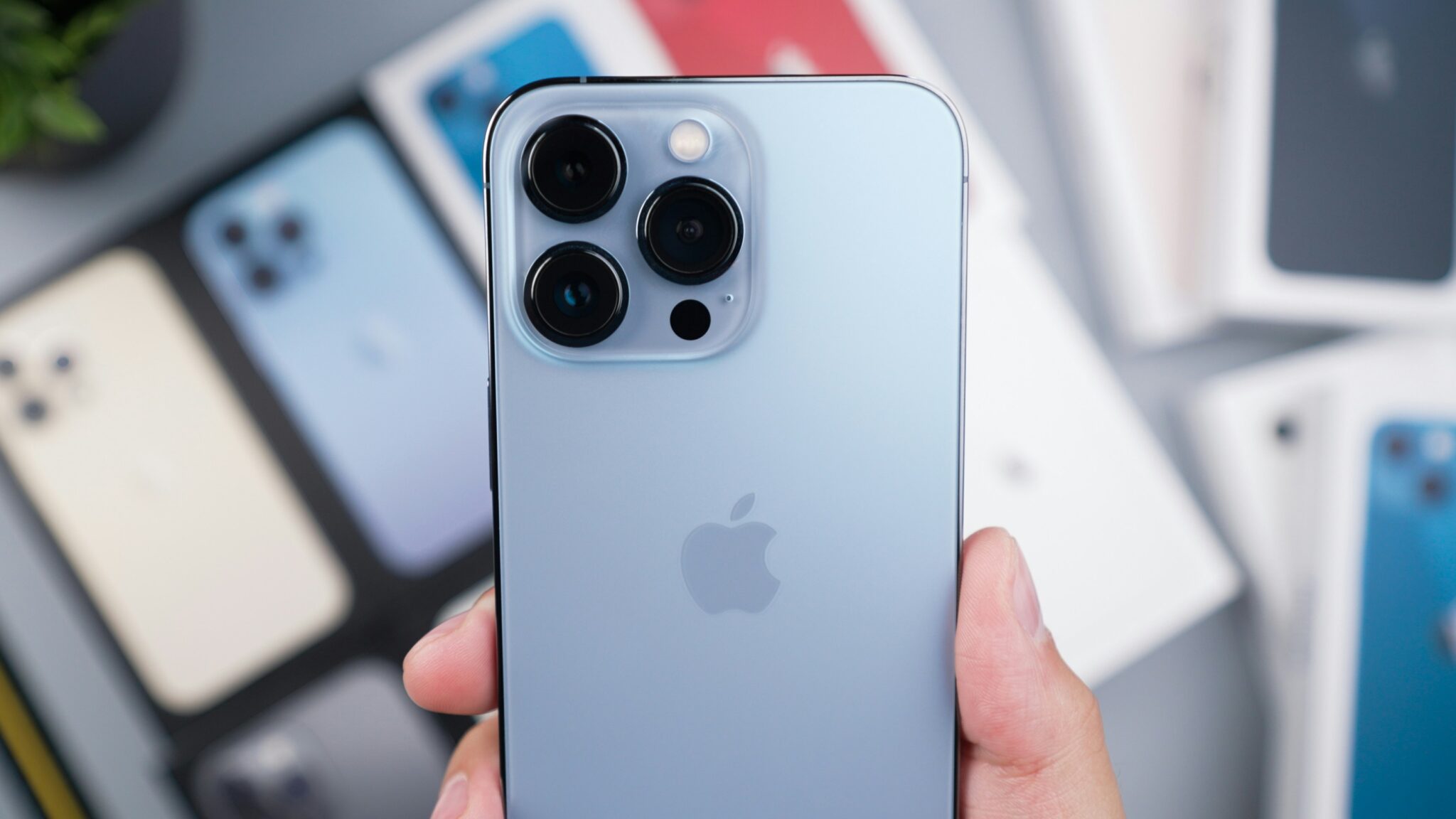
iPhone 13 Pro
Display
Both models feature Super Retina XDR OLED displays with ProMotion technology and an adaptive 120Hz refresh rate. Resolution is identical at 2532 x 1170 pixels (460 ppi).
The key display difference is brightness: the iPhone 15 Pro reaches 2,000 nits peak brightness outdoors, compared to 1,200 nits on the iPhone 13 Pro. That 67% increase in peak brightness makes a real difference when using the phone in direct sunlight.
Both displays support True Tone technology, which adjusts white balance to match ambient lighting, and the P3 wide color gamut with a contrast ratio of 2,000,000:1 for deep blacks and accurate color reproduction.
The 15 Pro also has thinner bezels, giving it a marginally more immersive appearance at the same 6.1-inch diagonal size.
Performance
The iPhone 15 Pro is powered by the A17 Pro chip, built on TSMC's 3nm process, compared to the 5nm A15 Bionic in the iPhone 13 Pro. Apple reports roughly 10% faster CPU performance and 20% faster GPU performance generation-over-generation.
The A17 Pro features a 6-core CPU with 2 high-performance cores and 4 efficiency cores, plus a 6-core GPU with hardware-accelerated ray tracing. This makes the 15 Pro the first iPhone capable of console-quality lighting effects in demanding games.
The improved Neural Engine in the 15 Pro also accelerates machine learning tasks, benefiting features like computational photography, AI apps, and on-device Siri processing.
The performance difference is most noticeable in demanding workloads: 4K ProRes video editing, 3D gaming, and running multiple heavy apps simultaneously. For everyday tasks like messaging, browsing, and social media, the A15 Bionic in the 13 Pro remains entirely capable.
Both chips handle iOS 26 smoothly in 2026. The A15 Bionic is still a powerful processor and shows no signs of struggle with current apps or features.
Cameras
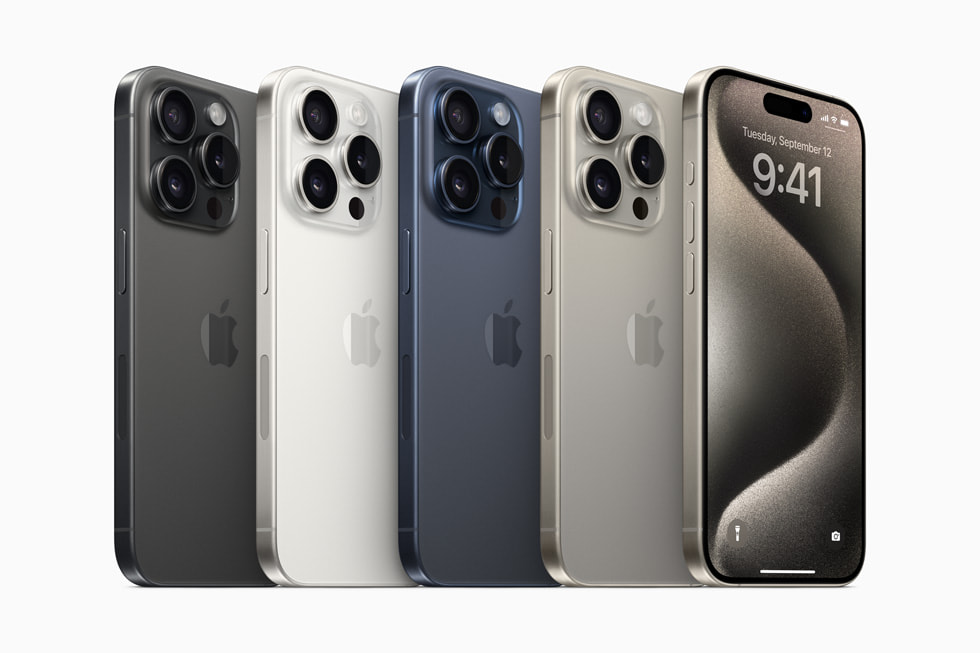
iPhone 15 Pro models Image by: Apple
Both phones use a triple-camera system, but the iPhone 15 Pro brings a major upgrade to the main sensor:
- Main camera:
- iPhone 13 Pro: 12MP, f/1.5 aperture
- iPhone 15 Pro: 48MP, f/1.78 aperture with sensor-shift optical image stabilization
- Ultra-wide camera:
- iPhone 13 Pro: 12MP, f/1.8 aperture
- iPhone 15 Pro: 12MP, f/2.2 aperture (with improved sensor and autofocus)
- Telephoto camera:
- Both models: 12MP, f/2.8 aperture, 3x optical zoom
The 48MP main sensor on the 15 Pro is the headline upgrade. Apple uses pixel binning to combine four pixels into one, producing 12MP images with better low-light performance and less noise. Photographers can also shoot full 48MP ProRAW images for maximum detail and editing flexibility.
The 15 Pro's computational photography benefits from the A17 Pro chip: improved Smart HDR, stronger Night mode, and an enhanced Portrait mode that lets you adjust the focus point after capturing the shot.
Video is where the gap is most pronounced. Both models support 4K60 with Dolby Vision, but the 15 Pro adds ProRes video recording at up to 4K60, a professional-grade capability previously reserved for cinema cameras and high-end mirrorless systems.
For most users, the 13 Pro's camera system is still excellent in 2026. The 15 Pro's advantages are most meaningful for photographers and videographers who push their phone's imaging capabilities.
Battery life and charging
Both models offer all-day battery life. Apple's rated figures are close:
- iPhone 13 Pro: Up to 22 hours of video playback
- iPhone 15 Pro: Up to 23 hours of video playback
In practice, the 15 Pro's more efficient A17 Pro chip can extend real-world battery life further, particularly under mixed workloads.
The most significant difference is the charging port:
- iPhone 13 Pro: Lightning port, fast charging up to 27W (wired), MagSafe up to 15W, Qi up to 7.5W
- iPhone 15 Pro: USB-C port, fast charging up to 27W (wired), MagSafe up to 15W, Qi up to 7.5W
The USB-C port on the 15 Pro also enables reverse charging, so you can charge AirPods or Apple Watch directly from the iPhone. It also supports USB 3 speeds (up to 10 Gb/s) for fast file transfer when connected to a Mac or external storage, compared to USB 2 speeds on the 13 Pro's Lightning port.
Software support in 2026
Both the iPhone 13 Pro and iPhone 15 Pro support iOS 26, released by Apple in fall 2025. This means both phones receive the same new features, security patches, and app updates through at least 2026 and beyond.
Apple has historically supported iPhone Pro models for five to six years. The iPhone 13 Pro, released in September 2021, will likely receive iOS updates through 2026 or 2027. The iPhone 15 Pro has several more years of guaranteed support ahead of it.
If long-term software longevity is a priority, the 15 Pro has a clear advantage. For most buyers in 2026, however, both phones are fully current and well-supported.
Refurbished value in 2026
In the refurbished market, the iPhone 13 Pro has dropped substantially in price since launch, making it one of the best-value Pro iPhones available. You can often find certified refurbished 13 Pro units from reputable sellers at a fraction of the original $999 retail price.
The iPhone 15 Pro, released in September 2023, is still closer to its launch price in the refurbished market, but deals are becoming more frequent as the iPhone 16 Pro draws buyers toward the latest model.
When shopping refurbished, look for:
- Grade A or Grade B certified units with no functional defects
- Warranty coverage of at least 12 months
- Trusted sellers such as Apple Certified Refurbished, Back Market, Amazon Renewed, and Gazelle
RefurbMe compares live prices across all major refurbishers so you can find the best deal on either model. See our guide to the best places to buy refurbished iPhones for a full breakdown of where to shop.
Conclusion
Both the iPhone 13 Pro and iPhone 15 Pro are excellent smartphones with strong performance, capable triple cameras, and full iOS 26 support in 2026.
If you want the latest hardware, the best camera system, USB-C, and the longest software runway, choose the iPhone 15 Pro. The A17 Pro chip, 48MP sensor, ProRes video, and titanium frame are meaningful upgrades that will keep the phone competitive for years.
If you want outstanding performance at a lower price, the iPhone 13 Pro is a smart buy. The A15 Bionic handles every daily task with ease, the camera system is still excellent, and you get 120Hz ProMotion and 5G. At its current refurbished price, it offers exceptional value.
Compare live refurbished prices on both models right now.
More iPhone comparisons:
- iPhone 13 vs. iPhone 15
- iPhone 13 Pro vs. iPhone 14 Pro
- iPhone 13 Pro vs. Pro Max
- iPhone 13 Pro Max vs. iPhone 15 Pro Max
FAQ
Last updated: May 13, 2026 · First published: Aug 30, 2024